Appearance
Cross-Chain
Manage your token's presence across multiple blockchains with unified ownership and metadata.
Overview
Cross-chain linking gives your token one name recognized on every chain. Instead of managing separate registrations independently, your per-chain registrations are linked as peers — they share metadata and present a unified token page.
What you get:
- One name aggregating all your chain deployments
- Unified metadata synced across all linked registrations
- Token List standard output for wallet and exchange auto-ingestion
- Shared token page data across all chains
Adding a Chain
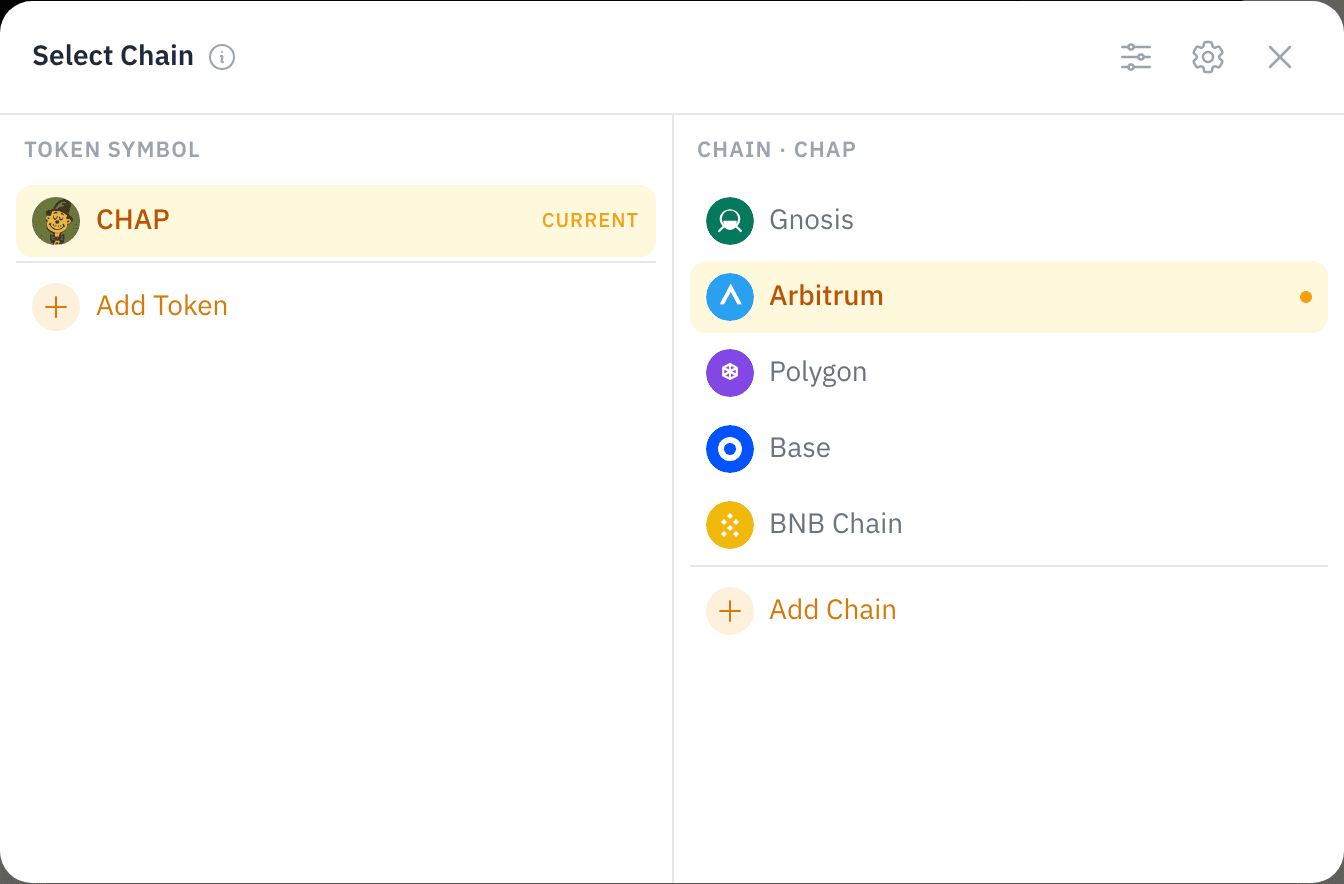
- Start from your token page or Token Manager: open the chain switcher and select Add Chain

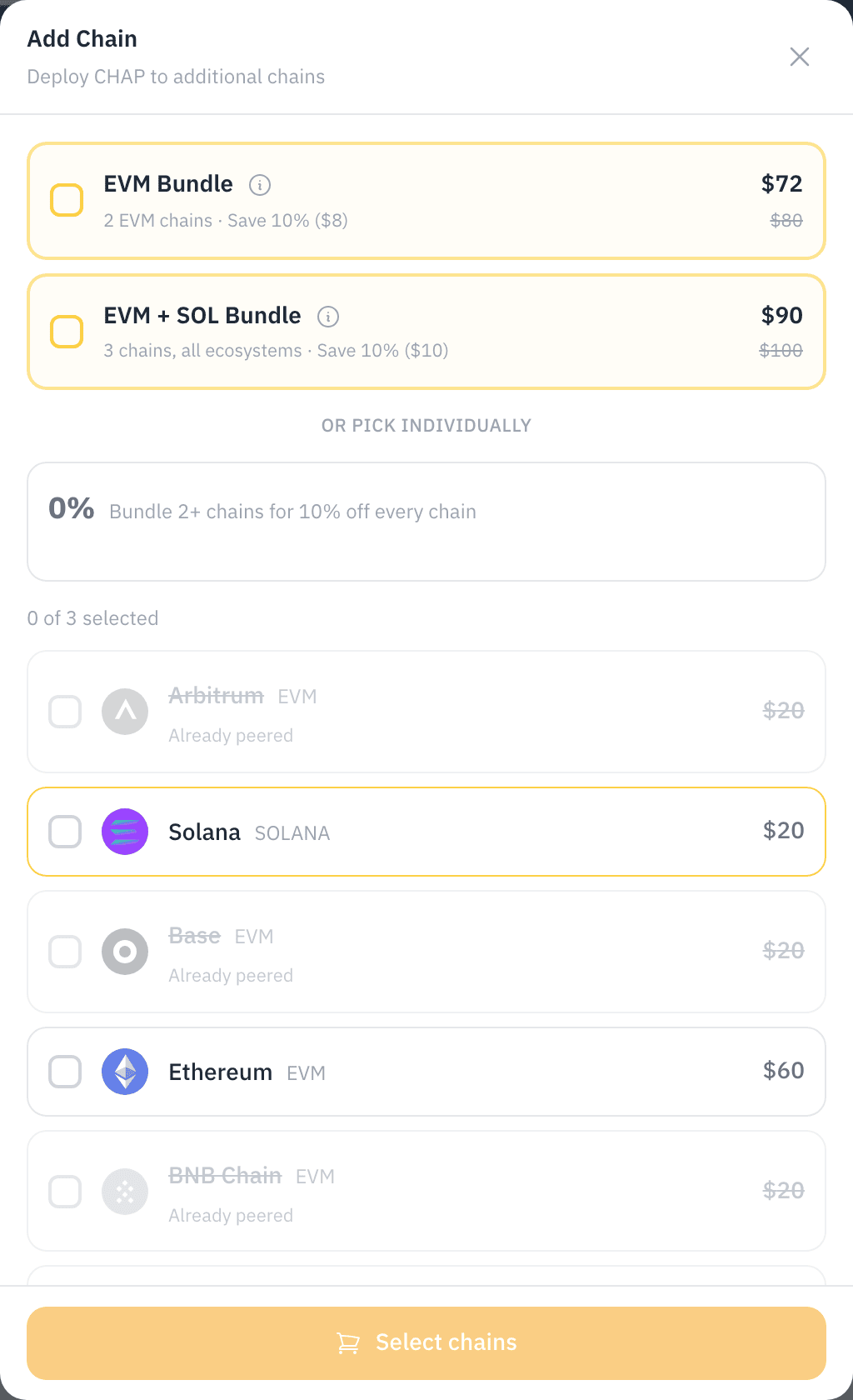
- Pick the chain: Chains you already have a registration on are marked "Already peered" and can't be double-added. Bundle two or more chains in one order for a 10% discount

- Register or create on that chain: Priced as a normal per-chain registration (or creation + registration) — see pricing. Registering 2+ chains in one order gets the multi-chain bundle discount
- Done: The new registration links to your existing ones automatically — no extra step, no linking fee
After the new registration confirms, all your chains appear together on the ticker's public token page.
Same wallet, not same creator
Linking is keyed on the wallet that owns the registrations — not the wallet that created each token:
- To link, register from the same wallet. Registrations only group into one token page when the same wallet owns them on every chain. Registrations made from different wallets stay separate.
- The token itself can come from anywhere. Each chain's token may have been deployed or created by a different wallet. What matters is that the wallet you're registering with passes that chain's ownership verification — deployer, contract owner, mint/update authority (Solana), or majority holder all qualify.
Supported Chains
| Chain | Type | Token Standard | Notes |
|---|---|---|---|
| Ethereum | EVM | ERC-20 | Higher gas costs |
| Arbitrum | EVM | ERC-20 | Low gas costs |
| Base | EVM | ERC-20 | Shared address across EVM chains |
| Polygon | EVM | ERC-20 | Shared address across EVM chains |
| BNB Chain | EVM | ERC-20 | Shared address across EVM chains |
| Avalanche | EVM | ERC-20 | Shared address across EVM chains |
| Gnosis | EVM | ERC-20 | Shared address across EVM chains |
| Solana | SVM | SPL | Native program, lowest fees |
EVM Same-Address Deployment
Tokens created through Chain Daddy on EVM chains share the same contract address across all EVM deployments, simplifying integration.
Solana Native Registrations
Solana registrations use native program accounts with Metaplex NFT compatibility. They appear in standard Solana wallets and can be linked to EVM registrations for cross-chain presence.
Linking Is Automatic
There is no separate linking step and no linking fee. When the same wallet registers the same ticker on another chain, the registrations link automatically as peers — you get:
- One name linking all your chain registrations
- Cross-chain metadata synchronization
- Token List standard inclusion
One signature per chain
"Automatic" means there's no separate linking step, transaction, or fee — the peering that groups your registrations happens on its own. But each chain's registration is its own on-chain action, so you sign once per chain as you add it. Registering on three chains is three signatures (one per registration); the grouping into a single token page then happens automatically, with no extra signature.
INFO
Multi-chain bundles are simply the discounted way to buy several chains at once — every multi-chain registration links automatically, bundled or not.
How Linking Works
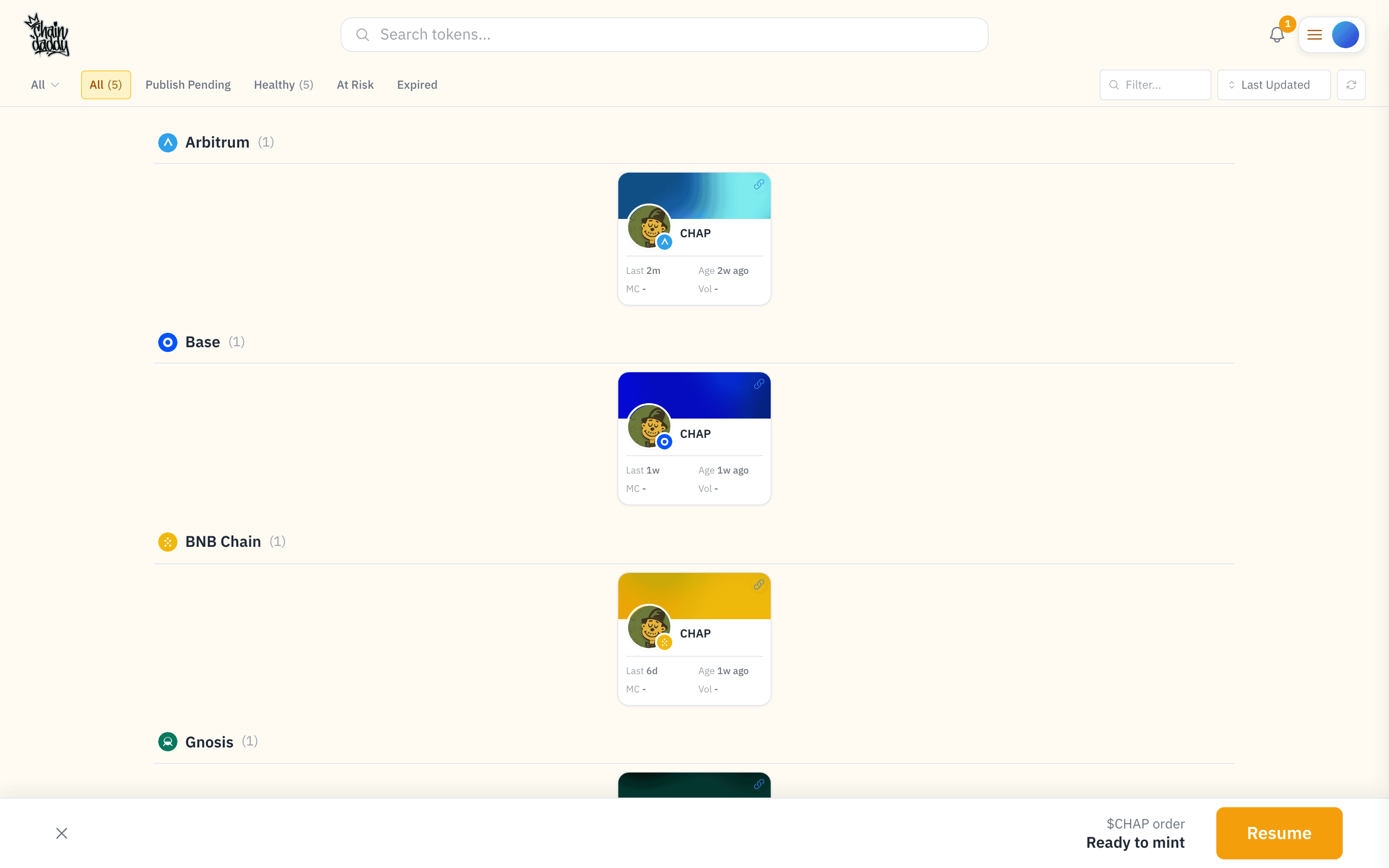
One name recognized on every chain — that's the whole model. Each ticker (e.g., DOGE) groups all per-chain registrations owned by the same wallet as equal peers, so your Arbitrum, Solana, and Base registrations present as one token, not three.

Owners see the same peer group grouped by chain in their dashboard: one ticker claimed on five chains by the same wallet, presented as one token.
Ticker Structure
Ticker: DOGE
└── Linked Registrations (same wallet):
├── Arbitrum → doge-arb
├── Solana → doge-sol
└── Base → doge-baseKey concepts:
| Concept | Description |
|---|---|
| Ticker | Top-level grouping for a token name across all chains |
| Linked Registrations | Per-chain registrations owned by the same wallet, sharing metadata |
| Representation | A per-chain registration under the ticker |
Peer Model
All linked registrations are equal. There is no "primary" or "master" designation. When the same wallet owns registrations for the same ticker on multiple chains:
- All registrations share a single set of metadata
- Editing any registration's metadata updates all linked registrations
- Each registration resolves independently via its chain-specific URL
One registration per chain per wallet
A wallet's peer group for a ticker admits at most one registration per chain. You can own DOGE on Arbitrum and DOGE on Base and DOGE on Solana — three distinct entries in the same peer group — but you cannot hold two Solana DOGE registrations under the same wallet. Attempting to add a second registration on a chain you already peer (for example, a second Solana DOGE registration with a different token address) is rejected at every layer: the Add Chain picker crosses the chain out with "Already peered", the API rejects the request before any transaction is built, and the on-chain registry reverts DuplicateChainInPeerGroup if a transaction still reaches it.
If you need to re-point a chain slot at a different token (for example, migrating DOGE on Solana from an old mint to a new one), remove the existing peer first, then add the new one. To keep multiple registrations of the same ticker on the same chain, use a different wallet — peer groups are per (ticker, wallet), so a second wallet can carry its own independent registration on that chain.
Unified Metadata
When registrations are linked, metadata changes sync across all representations:
| Field | Behavior |
|---|---|
| Name | Shared across all linked registrations |
| Description | Shared across all linked registrations |
| Logo | Shared across all linked registrations |
| Social links | Shared across all linked registrations |
| Token address | Per-chain (unique to each representation) |
| Contract details | Per-chain (unique to each representation) |
WARNING
Chain-specific fields (token address, contract details) remain unique per representation. Only registration-level metadata syncs across chains.
Token List Standard Output
Linked registrations automatically generate a Token List compatible JSON file. This follows the widely-adopted token list standard used by wallets and exchange aggregators.
What it includes:
- Token name, symbol, decimals
- Per-chain contract addresses with chain IDs
- Logo URI from your token metadata
- Version tracking for updates
Endpoints:
GET /tokenlist.json # All verified tokens
GET /tokenlist/arbitrum.json # Chain-specific list
GET /tokenlist/solana.jsonWallets and exchanges can subscribe to your token list for automatic metadata updates without manual listing applications.
TIP
Combined with Listing Export, cross-chain linking gives you one-click distribution of your token data to all major platforms.
Verification by Chain
Ownership verification methods differ between EVM and Solana due to different program and contract models. See Verification Methods for the full chain-vs-method matrix — deployer, contract owner, mint/update authority (Solana), and majority holder — and how strength rankings apply.
Costs
| Action | Fee |
|---|---|
| Linking | Free — automatic when the same wallet registers the same ticker on 2+ chains |
| Adding a chain | Normal per-chain registration/creation fee (see pricing) |
| Metadata sync | Free |
| Token List inclusion | Free |
TIP
Registering multiple chains in one order qualifies for multi-chain bundle discounts. See Create a Token for bundle options, and Registration & Creation Pricing for the current rate card.