
Ownership Deals
Launch a new coin with another creator, buy or sell a coin page, or move your holders to a new coin.
| You want to… | Use | Chains | Cost |
|---|---|---|---|
| Launch a new coin with another creator and split its creator fees | Collab | EVM | Free to agree |
| Buy a coin page and offer its holders a way out | Buyout offer | EVM | Fee out of the price |
| Buy the whole project: coin page, admin role, socials | Project acquisition | EVM and Solana | Fee out of the price |
| Move your holders to a new coin, recorded on chain | Consolidation | EVM and Solana | Free |
EVM chains are Ethereum, Base and the other chains that work like them. The first three start from Make Offer on the other creator's coin page. A consolidation starts from Consolidate in the Danger Zone of your coin manager's Admin tab.
Every offer starts with a check that the offering wallet holds the money. The owner accepts or rejects; there is no counter-offer. Nothing happens until both sides sign.
Your Chain Daddy registration (the on-chain record that you own this coin's short name, or ticker, here) can't be sent to another wallet. That is why a sale goes through a deal: both sides sign, then the seller's registration is replaced by a new one for the buyer.
Launch a new coin together
You and another creator launch a new coin together and split its creator fees (the creators' share of its trading fees). Your existing coins do not change.
- On their coin page, Make Offer → Collab.
- Set the new coin's ticker, their share of the creator fees, and the liquidity you commit (at least $1,000).
- They accept.
- Either of you presses Launch TICKER with this collab on the deal page. The new coin names both of you as fee recipients at the agreed split.
The new coin is an ordinary launchpad coin and Chain Daddy takes its usual launch share; your split divides the rest. To collect, the launcher claims from My Coins, and that one claim pays both of you. How to collect
The split is permanent once the coin launches
Both fee recipients and their shares are written into the pool when it is created. Nothing can change them afterwards.
On Robinhood Chain, a Protected open launch (the default there) has two fee streams. Your split covers the pool's swap fee; the other stream goes to the launcher. Each of you claims your own share: the partner uses Fees you share in on Rewards.
ⓘ Collab details
- Ticker. 16 characters or fewer. The launch must use exactly the agreed ticker.
- Their share. Above 0% and below 100%. It divides the creator side of the fees, after Chain Daddy's cut and the airlock floor.
- Liquidity. A commitment, not a deposit: nothing is taken or held. The offer records the figure and a funds check showing you held it. The launcher decides how much goes into the pool.
- Who launches. Either of you; the other gets their share either way. The launcher's wallet can't also be the partner's.
- Whose plan counts. The launcher's, at launch. It sets Chain Daddy's cut.
- No Boost, no extra fee recipients. A collab launch can't turn on Boost or add a fee split; either would change the split you both signed.
- When it ends. When the launch confirms on chain. Until then nothing expires it, and a collab that never launches owes nothing.
- Privacy. Its terms are visible only to the two of you until it launches, so nobody else can take the ticker first.
Buy or sell a coin page
| Buyout offer | Project acquisition | |
|---|---|---|
| The buyer gets | The coin page, plus anything on the assets list | The coin page, plus the assets list: usually the admin role, socials and domain |
| Holders get | Terms to convert out, published by the buyer | No conversion terms |
| Price | An amount in a currency the buyer picks | A % of market cap, or US dollars |
| Chains | EVM | EVM and Solana |
Buyout offer
The buyer sets:
- Amount and currency: what they pay.
- Redemption token and rate: the coin holders get, and how much of it for each coin they hold.
- Redemption window: 7, 14, 30, 60 or 90 days. 30 is the default, and gives holders who didn't choose the buyer time to act.
- Assets included: see below.
The redemption window is also how long the offer stays open. Once the owner accepts, the coin page shows holders the consolidation notice with the redemption coin, rate and deadline. The buyer, not Chain Daddy, honours the redemption.
Redemption contract
Optional. An address the buyer adds for holders to redeem through. Chain Daddy only checks that it looks like an address; it doesn't deploy, fund or call it. Leave it blank to handle redemptions by hand.
Assets included
What changes hands besides the coin page: the coin's owner() role (its admin controls), the X account, Discord server, Telegram group, website or domain, and "other". Only the coin page is selected by default.
The list can't be edited after the offer is made. It records what you agreed. Chain Daddy doesn't hand any of it over and can't check that it was.
Project acquisition
The whole project changes hands: the coin page plus the assets list.
When Chain Daddy can read the coin's market cap, the offer is a percentage of market cap (above 100% is allowed). Otherwise it is in US dollars, converted to the chosen currency at its current price. It is the only deal type for a Solana registration.
Move your holders to a new coin
A consolidation tells your holders, on your coin page, where to go, at what swap ratio, and by when. Only the owner can start one. It moves no coins and costs nothing; you run the swap yourself.
You set:
- Swap ratio:
1:2, or a number like1.5. - Destination token: the contract address (or Solana mint) of the coin holders move to.
- Swap window: 1 to 730 days from when you create it.
Then agree to it on the deal page. Holders see nothing until you do.
Record it on chain. After agreeing, sign once per chain. This links your registration to the destination's on chain, signed by you, so anyone can check the move is yours. Chain Daddy sends the transaction and pays the gas. The destination must be one of your registered coins. On Solana, sign with a wallet that can sign messages (Phantom, Backpack or Solflare). If you don't sign, Chain Daddy records the link when the window closes. Cancelling removes it.
Publish the terms. Then one transaction from your wallet adds the ratio, destination and deadline to your registration's metadata. You pay the gas for this one.
ⓘ Consolidation details
- Owner only. Refused if you don't hold the registration, or if ownership can't be checked right now.
- The destination is checked for shape only. Holders see the address you typed, and are told to check it themselves.
- One live window per registration.
- Your registration stays with you unless you retire it. Keeping it stops anyone else verifying the old coin.
Across several chains
Announce your move creates one consolidation per chain as a single set: up to 32 chains, one shared swap window. You agree them all at once, then sign once per chain to record them.
A set is all or nothing
Holders see nothing until every chain in the set is agreed. A cancelled member can't be revived, so you would create the set again.
Making an offer
Open Make Offer on the coin's page and pick a type. For a buyout: set the amount and currency, verify your funds, and set the redemption terms.
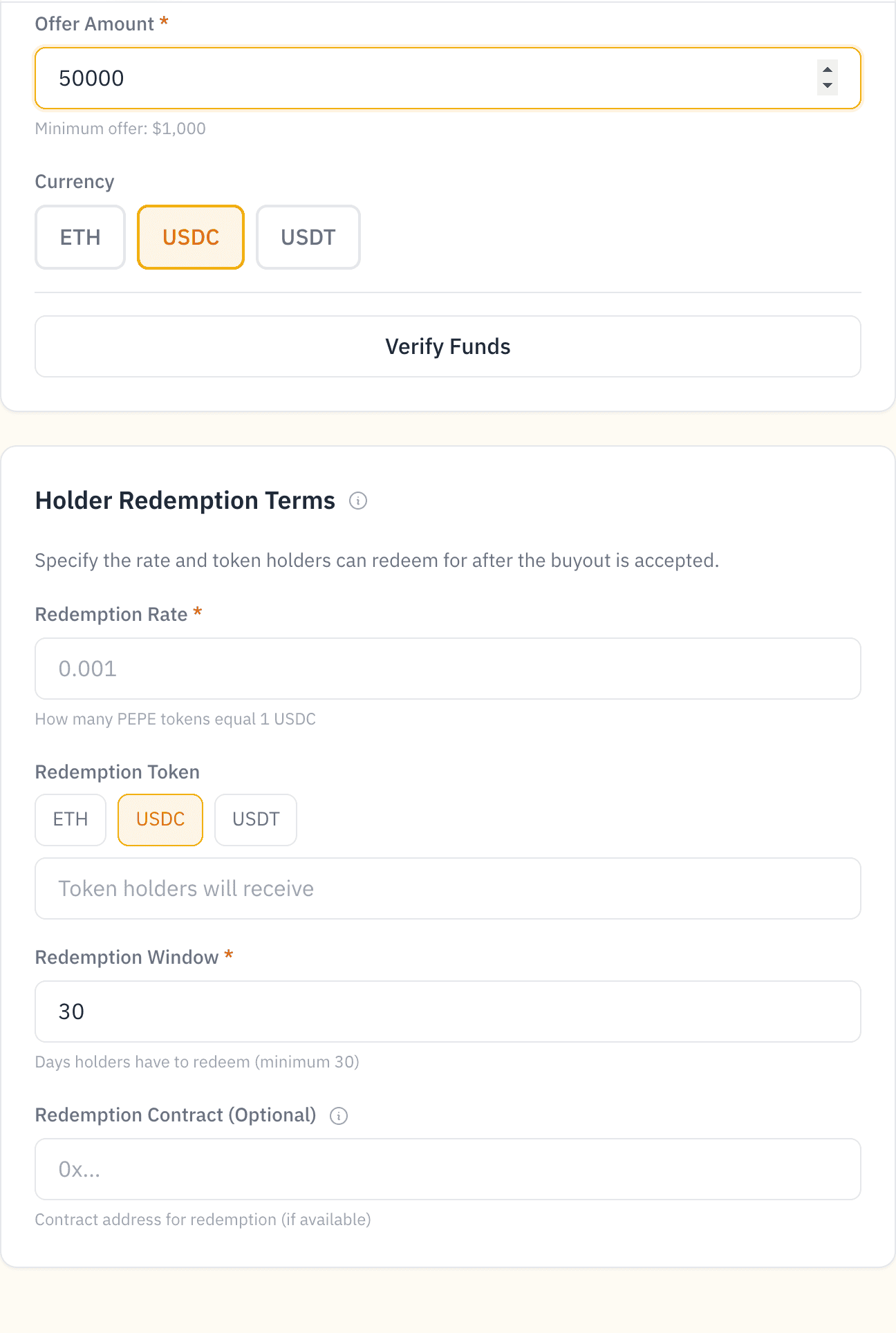
A collab or an acquisition stays open for 7, 14, 30, 60 or 90 days (default 30). A buyout stays open for its redemption window. An offer nobody answers in time is cancelled; make a new one.
Reviewing an offer
Offers on your coin appear in your deals, and you are notified. Open one for the full terms: amount, currency, buyer, their message, and how much of the offer they proved they hold. Then Accept or Reject.
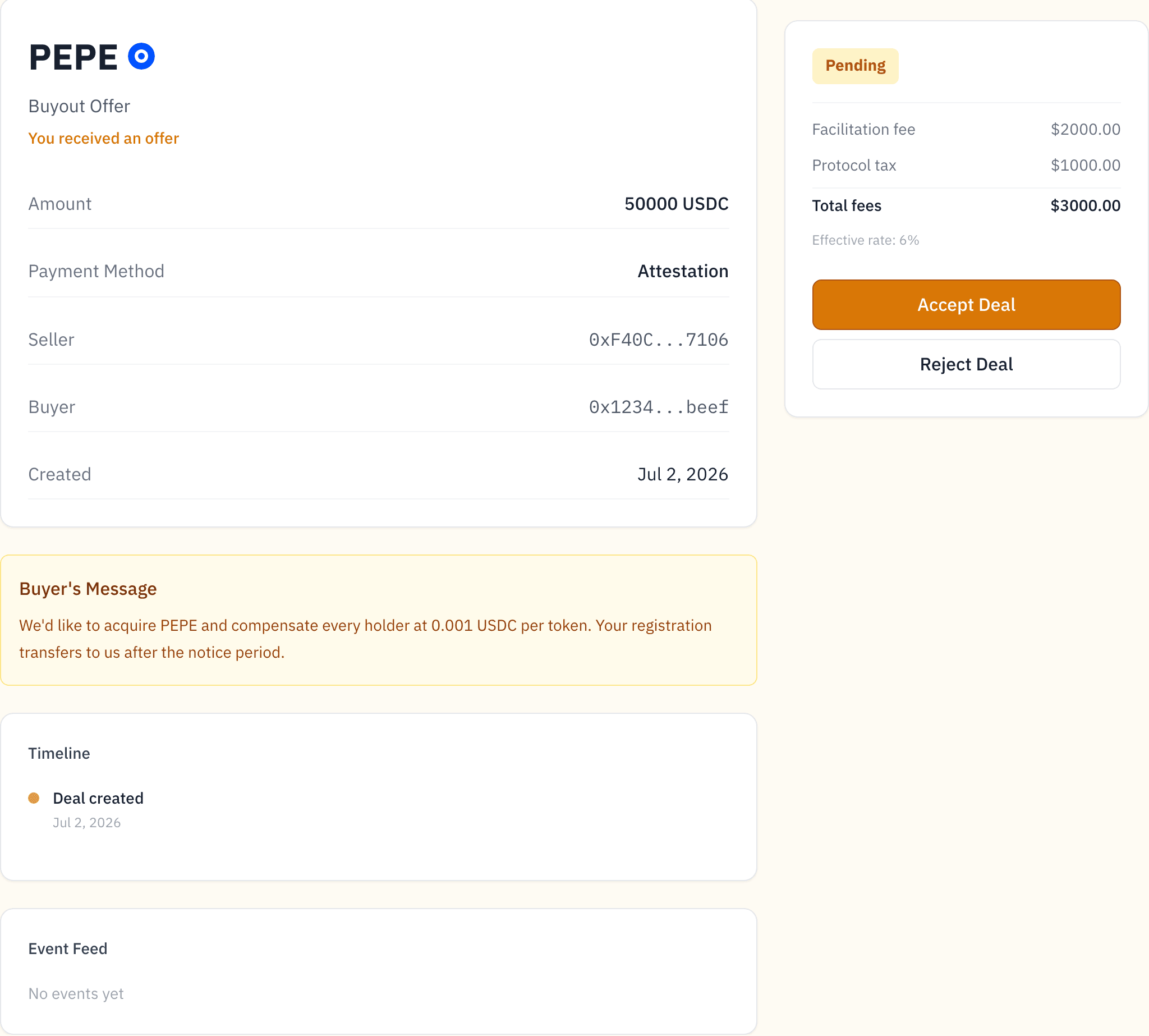
Accepting is a signature: no gas, no balance needed. On a sale it fixes Chain Daddy's fee.
One sale at a time per coin name. Several buyers can have live offers at once, but accepting a buyout or acquisition locks that name against a second sale, on every chain, until the first finishes or is cancelled. Collabs and consolidations aren't affected.
Control what you are offered
In Settings → Notifications → Offers on your registrations, for every coin you hold:
- Not accepting offers refuses every type, collabs included.
- Minimum offer sets your own floor above the $500 minimum, for buyouts and acquisitions. An offer below it is refused, and the offerer is told the figure.
Updates
New offers, acceptances and every settlement step reach you by email, push and in-app. Buyer and seller also get each update as a message to their wallet (XMTP).
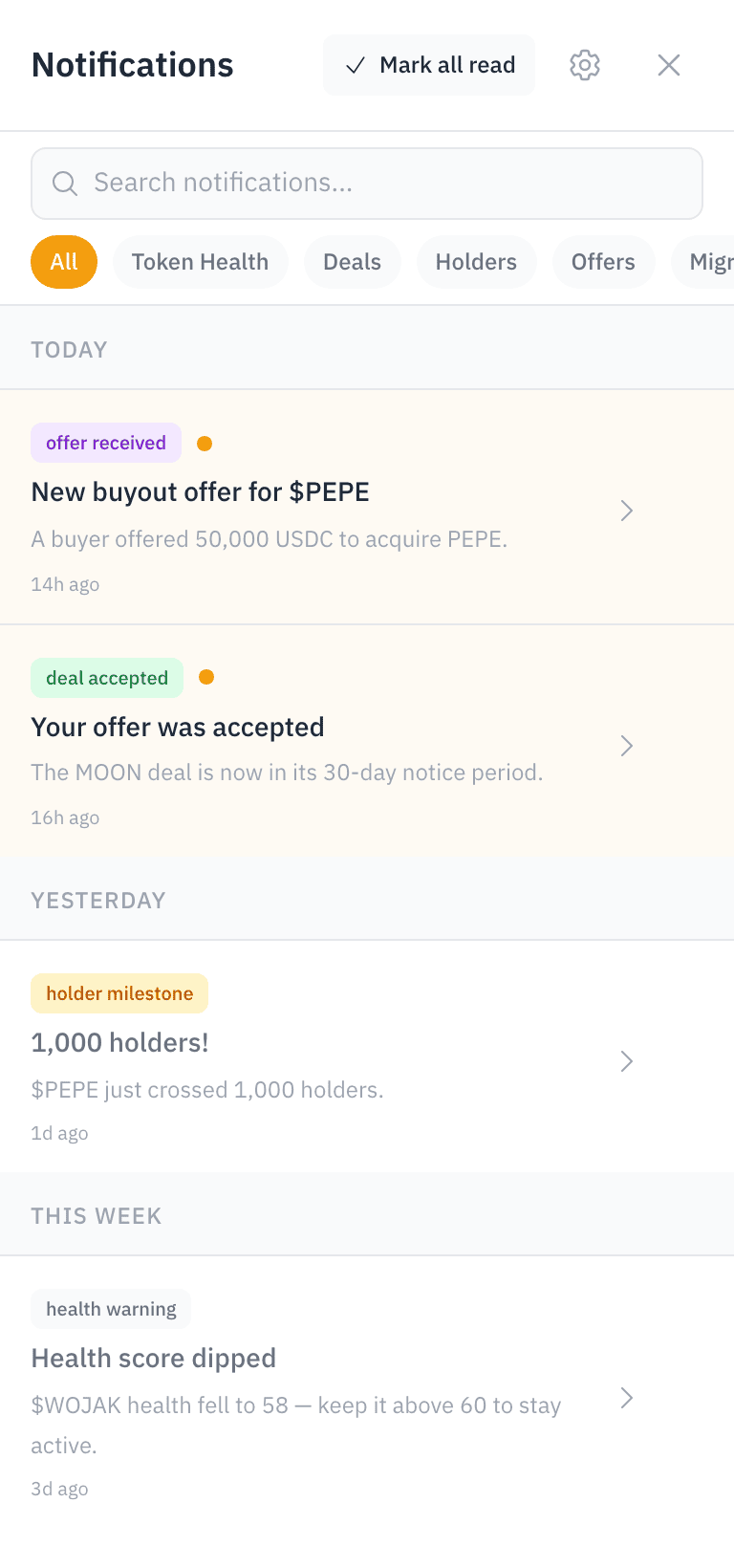
Holders of the coin can follow a deal from its deal page. On Pro and above you can follow any deal, while places last.
How settlement works
Only a buyout and a project acquisition settle. The buyer pays the price, the seller receives the price less Chain Daddy's fee, and the page moves to the buyer. The seller never pays gas.
- EVM: the buyer deposits the price into the chain's deal settlement contract. The seller signs once. Then one transaction replaces the seller's registration with the buyer's, pays the seller and pays the fee. All of it happens or none of it does.
- Solana: the seller's registration moves to a holding account. Then one transaction from the buyer pays in USDC (the seller and the fee) and creates the buyer's registration. If the buyer doesn't complete within the settlement window (7 days by default), the seller reclaims the registration from the deal page, and nothing has been paid.
ⓘ Step by step on EVM
- The buyer offers, with verified funds.
- The seller accepts with a signature. The fee is fixed.
- Chain Daddy quotes the terms: seller, buyer, registration, price, fee, and a deadline 14 days out.
- The buyer deposits the price in the chain's native coin or its dollar stablecoin (USDC; USDG on Robinhood Chain). This is the only gas either side pays.
- The seller signs one consent to the buyer, the price and the fee. If it lapses, they sign a fresh one.
- Chain Daddy settles and pays the gas. The seller can send it instead.
Refunds. If the deal is cancelled, the deposit goes back to the buyer. The seller can release it to the buyer at any time, and after the deadline anyone can. A refund only ever pays the buyer.
ⓘ Step by step on Solana
- The buyer offers and the seller accepts. The fee is fixed.
- Both sign the settlement terms, fee included.
- The seller submits the first transaction. Their registration moves to a holding account.
- The buyer submits the settlement: the USDC payment (to the seller, and the fee) and the new registration, in one transaction.
Chain Daddy pays the network fee on both.
Rules and limits
| Rule | Value |
|---|---|
| Minimum offer | $500 |
| The owner's own floor | Whatever they set, up to $100,000,000 |
| Funds check | Required for buyouts, acquisitions and collabs, on every chain |
| How much you must hold | The whole offer (a collab: the whole liquidity). Paying Partner or Enterprise: 80% |
| A funds check lasts | 1 hour |
| Offers you may make | 2 per rolling week on the free plan; no weekly cap on Pro and above |
| Value of your live offers | Your verified balance x1 free, x5 Pro, Pro+ and Developer, x10 paying Partner or Enterprise |
| Offer window (collab, acquisition) | 7, 14, 30, 60 or 90 days. Default 30 |
| Buyout redemption window | 7, 14, 30, 60 or 90 days. Default 30 |
| Consolidation swap window | 1 to 730 days |
| Chains in one consolidation set | 32 |
| Solana pricing | USDC only |
| EVM settlement deadline | 14 days after Chain Daddy quotes the terms |
| Making or withdrawing offers | 10 requests a minute per account |
Limits apply to your account, across every wallet linked to it. Using extra accounts or wallets to get around them breaks the Terms.
ⓘ How the limits are counted
- Minimum offer. An offer in a currency that can't be priced in dollars is refused.
- The funds check reads your balance; it doesn't hold your money. On Solana it reads USDC. At 80%, a Partner or Enterprise account can offer up to 125% of what it verified; trials must hold the whole offer. See the Fund Verification Terms.
- One hour covers verifying, reviewing and submitting. After that, verify again.
- Two offers a week (free). Each offer counts for seven days from when you made it, even if withdrawn or rejected. A consolidation never counts. Each offer in a set counts.
- Live offers are unanswered, or accepted and not yet paid. Your verified balance is what your funds checks from the last hour saw, across wallets, currencies and chains. A collab counts at its liquidity.
- Windows are exact. A value not on the list is refused.
- Offers in a set each clear the minimum and the owner's floor, are verified together, and are created and lapse together.
- 10 a minute is shared by making offers, making sets and cancelling.
What a deal costs
A sale (buyout or project acquisition) pays Chain Daddy a fee out of the price. The buyer pays the agreed amount; the seller receives it less the fee. The same on EVM and Solana, and on every plan.
The fee has two parts. A facilitation fee on a sliding scale, where each rate applies only to the part of the price in its band:
| Part of the price | Rate |
|---|---|
| First $25,000 | 5% |
| $25,001 to $100,000 | 3% |
| $100,001 to $500,000 | 2% |
| Above $500,000 | 1% |
At least $50, at most $20,000. Plus a protocol contribution of 2%, at most $10,000. No deal pays more than $30,000, or more than 12% of the price.
Launch discount: half off the facilitation fee for the first 10 fee-paying deals settled on Chain Daddy.
| Price | Facilitation | Protocol | Total fee | Seller receives | Effective rate |
|---|---|---|---|---|---|
| $500 | $50 (floor) | $10 | $60 | $440 | 12.0% |
| $5,000 | $250 | $100 | $350 | $4,650 | 7.0% |
| $25,000 | $1,250 | $500 | $1,750 | $23,250 | 7.0% |
| $50,000 | $2,000 | $1,000 | $3,000 | $47,000 | 6.0% |
| $100,000 | $3,500 | $2,000 | $5,500 | $94,500 | 5.5% |
| $500,000 | $11,500 | $10,000 (cap) | $21,500 | $478,500 | 4.3% |
| $1,000,000 | $16,500 | $10,000 (cap) | $26,500 | $973,500 | 2.7% |
| $2,000,000 | $20,000 (cap) | $10,000 (cap) | $30,000 | $1,970,000 | 1.5% |
Without the launch discount. On $50,000: $25,000 at 5% ($1,250) plus $25,000 at 3% ($750) is $2,000, plus $1,000 protocol.
ⓘ How the fee is fixed and paid
- Fixed when the seller accepts, on the accepted price. A price in ETH or another coin is valued in dollars at that moment.
- Paid in the price's currency, as the same share of the price. Rounding favours the seller.
- Both sides sign it, as part of the settlement terms.
- The launch discount counts settled fee-paying deals across all of Chain Daddy, and is decided at acceptance. It halves the facilitation fee, floor included, not the protocol contribution.
- Plans don't change it. Both parts go to Chain Daddy.
Everything else is free: making, accepting, rejecting and cancelling offers, and consolidating. On EVM the buyer pays gas once, to deposit, and Chain Daddy pays the gas to settle. On Solana, Chain Daddy pays the network fee on both settlement transactions.
A collab is free to agree, but the coin it launches pays the usual launch share. Chain Daddy takes 20% of its pool's trading fees on a free, monthly or trial plan, 15% on a yearly Pro, Pro+ or Developer plan, and 5% on a yearly Partner plan or any Enterprise plan, by the launcher's plan at launch. The underlying protocol takes another 5%. Your split divides the rest. How launch fees work
Cancelling
Either side can cancel. A cancelled deal can't be reopened.
- Before settlement, cancelling is free and changes nothing on chain. On EVM, any deposit goes back to the buyer.
- Once settlement is under way, the deal can only complete or fail. On EVM that is one transaction. On Solana, see the reclaim.
If something goes wrong
- You change your mind before settlement. Cancel. On EVM any deposit goes back to the buyer.
- The buyer's wallet is compromised. Cancel before settlement and take a new offer. The seller's consent names the buyer, so it can't be redirected.
- An EVM settlement fails. Nothing changes: the registration and the deposit stay where they were. Sign again, or cancel.
- The buyer deposits and the deal stalls. After the deadline, anyone can return the deposit to the buyer.
- A Solana settlement stops half-way. After the settlement window, the seller reclaims the registration from the deal page. Nothing was paid.
- A collab never launches. Nothing expires it and nothing is owed.